
Digital Transformation Playbooks: 5 Challenges That Sink Enterprise Transformations (And How to Avoid Them)
The $1.3 Trillion Problem
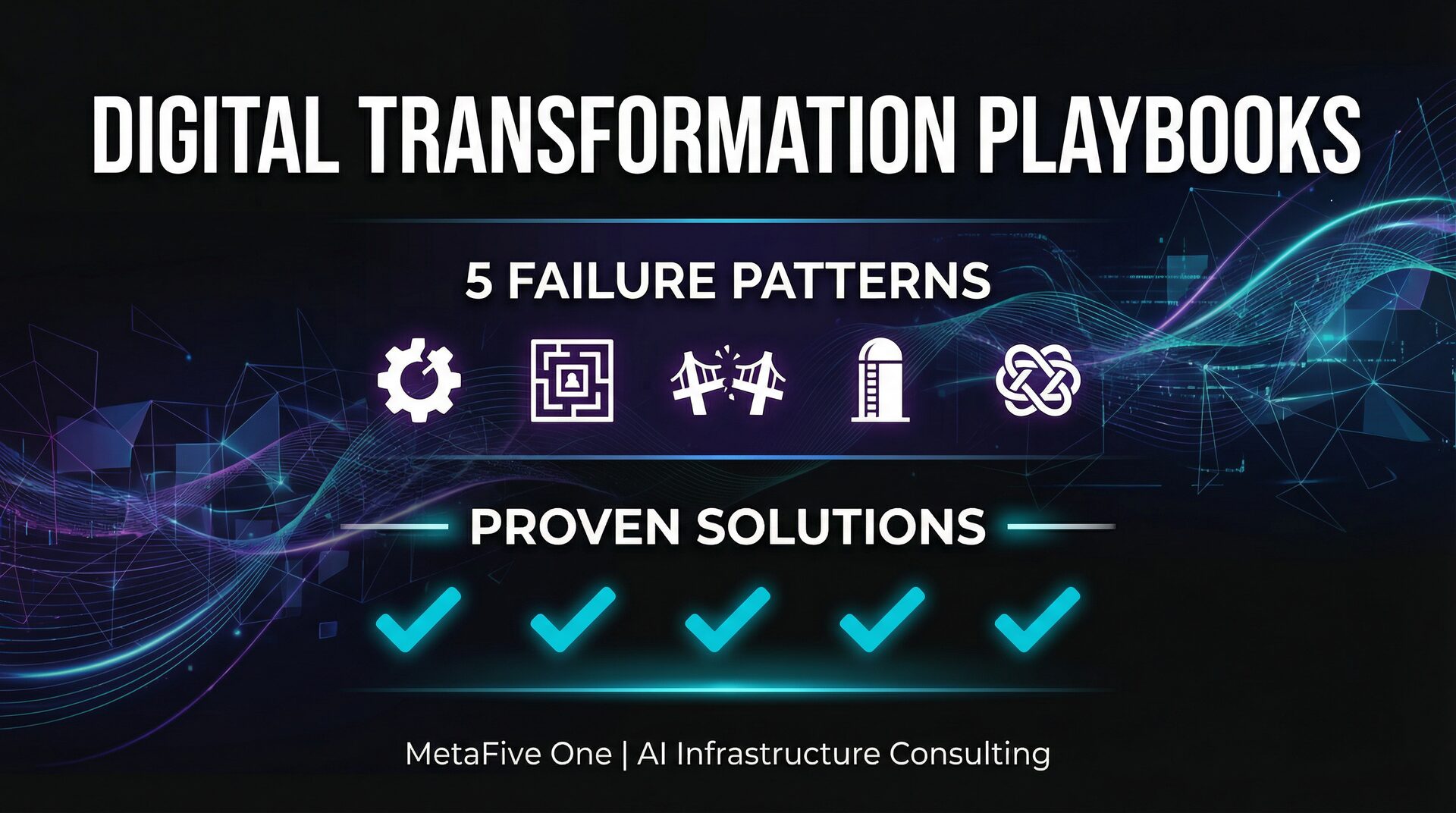
Enterprise digital transformation projects fail at an alarming rate. According to McKinsey research, 70% of digital transformations fail to achieve their objectives, resulting in over $1.3 trillion in wasted investment annually. The culprit? It's rarely the technology. The real obstacles are cultural resistance, poor migration strategies, skills gaps, inability to demonstrate value, and security afterthoughts.
After leading complex transformation initiatives across government, healthcare, finance, and technology sectors for over 20 years, we've identified the five most common failure patterns—and more importantly, the proven solutions that turn skeptics into champions and deliver measurable business value.
This article draws from our Digital Transformation Playbooks repository, which contains battle-tested frameworks for change management, stakeholder engagement, and legacy modernization.
The Foundation: People First, Technology Second
The most critical insight from two decades of transformation work is this: successful digital transformation is not just about technology. It's about people, process, and culture. The organizations that thrive are those that work closely with all stakeholders to develop a shared vision, build a culture of innovation and collaboration, and use data-driven approaches to measure progress and deliver real business value.
This people-first philosophy aligns with the broader industry shift toward human-led, AI-augmented infrastructure—where AI agents handle routine complexity (80%), allowing human teams to focus on high-value innovation and strategic architecture (20%).
Challenge 1: Resistance to Change & Entrenched Silos
The Problem
The biggest obstacle in any digital transformation is often not technology, but culture. Organizations frequently face significant resistance from teams accustomed to legacy workflows and operating in entrenched silos. There is a pervasive fear of the unknown and a reluctance to abandon familiar tools and processes that have "always worked."
Real-world impact: A European healthcare provider spent €5M on a cloud migration project, only to see adoption stall at 15% because development teams refused to abandon their on-premise workflows. The technical migration was flawless—the cultural migration never happened.
The Optimal Solution
A people-first approach to change management is critical. This involves building psychological safety, creating a shared vision, and empowering teams to own the transformation.
Proven tactics:
Instead of top-down mandates, form cross-functional working groups that include members from every relevant department (development, operations, security, business). Empowering these groups to make decisions about the new platform creates a sense of ownership and can turn skeptics into champions.
Communicate the "why" behind the transformation. The focus should not just be on new technologies, but on the tangible benefits for customers and how the changes will make employees' work more meaningful and less frustrating. When a Middle Eastern government agency reframed their cloud migration as "reducing manual toil so engineers can focus on innovation," adoption jumped from 20% to 85% in six months.
Break down monolithic transformation projects into small, achievable milestones. Celebrating every small win builds momentum and shows tangible progress. One financial services firm held monthly "transformation showcases" where teams demoed their progress—turning the project from an abstract initiative into a visible, exciting movement.
Challenge 2: The "Big Bang" Migration Trap
The Problem
A "big bang" migration—a single, massive cutover from an old platform to a new one—is a notoriously risky approach. It carries a high probability of catastrophic failure, extended downtime, and a negative impact on customers.
Real-world impact: A major telecommunications provider attempted a weekend "big bang" migration of their billing system to the cloud. The cutover failed, resulting in 72 hours of downtime, €12M in lost revenue, and a 40% drop in customer satisfaction scores.
The Optimal Solution
An incremental, iterative migration strategy, such as the Strangler Fig Pattern, is a much safer and more effective approach.
How it works:
The Strangler Fig Pattern involves identifying the boundaries of the legacy system and gradually "strangling" it by building new features and migrating existing ones to the new cloud-native platform. A reverse proxy placed in front of the legacy application routes traffic to either the new or the old system on a per-endpoint basis.
For a period of time, run both systems in parallel, using feature flags to control user routing. This allows you to de-risk the migration, compare performance, and enable quick rollbacks if issues are encountered. One European e-commerce platform used this approach to migrate 200+ microservices over 18 months with zero customer-facing downtime.
Once a part of the legacy system is fully strangled and no longer receiving traffic, hold a "decommissioning ceremony"—a powerful symbolic act that celebrates progress and provides closure. This ritual reinforces the cultural shift and gives teams permission to let go of the old system.
Challenge 3: Lack of Cloud-Native Skills & Expertise
The Problem
Teams that are experts in a legacy on-premise stack may have limited experience with cloud-native technologies like Kubernetes, serverless, and infrastructure as code (IaC). This skills gap can threaten to derail even the most well-planned transformation.
Real-world impact: A government agency allocated €8M for a Kubernetes-based platform modernization, only to discover that their 50-person engineering team had zero production Kubernetes experience. The project stalled for 14 months while they scrambled to hire external consultants.
The Optimal Solution
A comprehensive upskilling and enablement program is needed to build the necessary expertise in-house.
Proven tactics:
Establish a Cloud Center of Excellence (CCoE) composed of experienced cloud engineers. This team's primary role should be to enable other teams, not just do the work. They provide training, create best-practice templates, and act as internal consultants.
Invest in hands-on, immersive training programs. Classroom training alone is insufficient—engineers need to get their hands dirty. Run regular "Game Days" where teams practice responding to simulated cloud failures (e.g., "What happens if an entire availability zone goes down?"). This builds practical, real-world skills in a safe environment.
Embed members of the CCoE directly into development squads for short periods (4-8 weeks). This "pair programming" approach is one of the most effective ways to transfer knowledge and build confidence. One technology company used this model to upskill 120 engineers in 12 months, reducing their reliance on external consultants by 80%.
Challenge 4: Inability to Demonstrate Business Value Quickly
The Problem
Digital transformations are often long, expensive projects. It can be difficult to maintain executive buy-in when the business value is not immediately apparent. CFOs and CEOs want to see ROI measured in quarters, not years.
Real-world impact: A manufacturing company invested €15M in a three-year platform modernization initiative. After 18 months with no visible business impact, the CFO cut the budget by 60%, forcing the team to abandon half-completed work.
The Optimal Solution
Focus on identifying and delivering quick wins that are directly tied to business outcomes.
Proven tactics:
Map out the entire value stream, from idea to production, to identify the biggest bottlenecks. Targeting initial transformation efforts at these bottlenecks can deliver rapid and visible improvements. For example, if manual deployments are the biggest bottleneck, automating CI/CD pipelines can cut release cycles from weeks to hours—an immediate, measurable win.
Create a transformation dashboard that tracks not just technical metrics (like deployment frequency) but also business metrics (like customer satisfaction, revenue per feature, and time-to-market). This makes the value of the work visible and undeniable to the executive team. One financial services firm tracked "time from idea to customer" and showed a 65% reduction in six months—a metric that resonated with the CEO far more than "number of Kubernetes clusters deployed."
When prioritizing what to migrate next, use the "Cost of Delay" framework. Ask: "What is the cost to the business for every week that this feature remains on the legacy platform?" This helps focus on the most impactful work first. A healthcare provider used this framework to prioritize migrating their patient portal (high cost of delay due to regulatory fines) over their internal HR system (low cost of delay).
Challenge 5: Neglecting Security & Compliance Until the End
The Problem
In the rush to modernize, there is often a temptation to treat security and compliance as an afterthought—something to be "bolted on" at the end. This is a recipe for disaster, leading to costly rework, significant security vulnerabilities, and regulatory fines.
Real-world impact: A financial services firm completed a cloud migration, only to discover during a pre-launch audit that 40% of their infrastructure violated PCI-DSS compliance requirements. They spent an additional €3M and six months remediating issues that could have been prevented with upfront security design.
The Optimal Solution
A "Shift Left" approach to security and compliance, embedding it into every stage of the development lifecycle, is essential.
Proven tactics:
Break down the silos between development, security, and operations to create a shared responsibility for security. Security experts should be involved from the very beginning of any transformation initiative—not brought in at the end to "audit" the work.
Codify security and compliance policies using tools like Open Policy Agent (OPA) or Sentinel. This allows policies to be automatically enforced in CI/CD pipelines, preventing non-compliant infrastructure from ever being deployed. One government agency used OPA to enforce encryption-at-rest policies, reducing compliance violations from 200+ per month to zero.
Instead of a once-a-year audit, implement continuous auditing using tools that constantly monitor the cloud environment for compliance deviations. This allows an organization to maintain a state of "continuous compliance" and be audit-ready at all times. A healthcare provider used AWS Config and Security Hub to achieve continuous HIPAA compliance, reducing audit preparation time from 6 weeks to 2 days.
The Path Forward: From Failure to Success
Digital transformation is not a technology problem—it's a people, process, and culture problem. The organizations that succeed are those that:
- Build psychological safety and empower cross-functional teams to own the transformation
- Use incremental migration strategies (like Strangler Fig) instead of risky "big bang" cutovers
- Invest in upskilling programs (CCoE, Game Days, embedded coaching) to build cloud-native expertise in-house
- Deliver quick wins tied to business outcomes and track both technical and business metrics
- Embed security and compliance from day one using "Shift Left" practices and continuous auditing
These are not theoretical frameworks—they are battle-tested playbooks from over 20 years of leading transformations across government, healthcare, finance, and technology sectors.
Access the Full Playbooks
The complete Digital Transformation Playbooks repository on GitHub contains detailed frameworks, case studies, and best practices for:
- Change management and stakeholder engagement
- Legacy modernization patterns (Strangler Fig, Parallel Run, etc.)
- Cloud Center of Excellence (CCoE) setup and operation
- Transformation metrics and dashboards
- Security and compliance automation
Disclaimer: All examples in this article and the repository are generalized and do not reveal internal technical stacks, specific implementation details, or proprietary information related to past employers or customers.
Need Help with Your Transformation?
If your organization is struggling with digital transformation, we offer a FREE 30-Minute AI Readiness Audit where we'll:
- Run our AI-powered cost analyzer on your AWS environment (guaranteed €1,000+ monthly savings or the audit is free)
- Identify gaps in your data architecture, use case definition, and implementation roadmap before expensive failures occur
- Evaluate observability gaps, security vulnerabilities, and automation opportunities in your current platform
- Provide an actionable roadmap with prioritized quick wins and strategic initiatives
Book Your Free Audit | Email Directly
No sales pitch. No obligation. Just 30 minutes of focused analysis from a Global Platform and Infrastructure Director with 25+ years of enterprise infrastructure experience.
This article is based on the author's 20+ years of experience leading digital transformation initiatives across government, healthcare, finance, and technology sectors. All examples are generalized to preserve confidentiality.
Share this article
Comments (0)
You must be signed in to post a comment.
Sign In to CommentNo comments yet. Be the first to share your thoughts!